A Spanish painter born in Valencia in 1863 and died in Madrid in 1923, Joaquín Sorolla y Bastida remains one of the major figures of the art of his time. Often called the "master of light", he built a body of work in which the Mediterranean sun, beach scenes and portraits meet with the same demand for accuracy and vitality. To discover Sorolla is to travel an itinerary that runs from the modest beginnings of a Valencian orphan to international recognition, by way of a manner of painting recognisable among all. This overview sets out to retrace his journey, to touch on some of his works and to define the traits of a style that continues to be admired and sought after in reproduction.
A journey from Valencia to international recognition
Joaquín Sorolla was born in Valencia in 1863, in a city whose distinctive light would lastingly shape his sensibility. Orphaned at a very young age, he was raised by his aunt and uncle, who recognised early on his taste for drawing. These modest beginnings did not prevent him from pursuing an artistic training: he studied in Valencia before moving to Madrid, where he frequented the collections of the Prado Museum. It was there that he came face to face with the great masters of Spanish painting, foremost among them Velázquez and Goya, whose example would nourish his reflection on light, colour and the presence of figures.
Like many artists of his generation, Sorolla rounded out his training with stays abroad, notably in Italy and in Paris, where he took the measure of the pictorial currents of his day. Gradually he established himself as a recognised painter, whose canvases travelled beyond Spain's borders and met with notable success at international exhibitions. This recognition made him, in his lifetime, a kind of ambassador of Spanish painting, whose name circulated in the great artistic capitals.

His career led him to take on ever more commissions and subjects, from the portrait to the genre scene, from landscape to large decorative compositions. Until his death in 1923, he maintained a sustained activity, driven by a constant quest for light and movement. Today, his Madrid home, which has become the Sorolla Museum, preserves an important part of his work and bears witness to the world of a painter deeply attached to his studio and to his everyday surroundings.
Works between social realism and Mediterranean light
Sorolla's work cannot be reduced to the sunlit scenes alone that made him famous. The painter also took on grave subjects, rooted in the social reality of his time. "White Slavery" offers a striking example of this: the composition addresses the fate of young women being exploited, treated with a restraint that gives the subject all its gravity. This darker vein is a reminder that Sorolla was, in his early days, alert to a painting of protest and of attentive observation of living conditions.

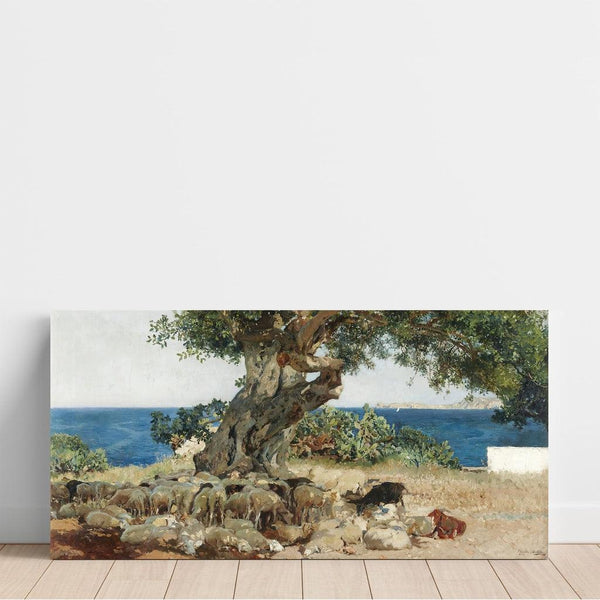
Alongside these subjects, the artist also painted places and scenes linked to commissions or to particular stays. "Chapel at the Láchar Estate" thus belongs to the world of the estates and landscapes of southern Spain, where Sorolla found material to observe light, architecture and local atmospheres. These works show a curious painter, able to move from one register to another without giving up his precision.
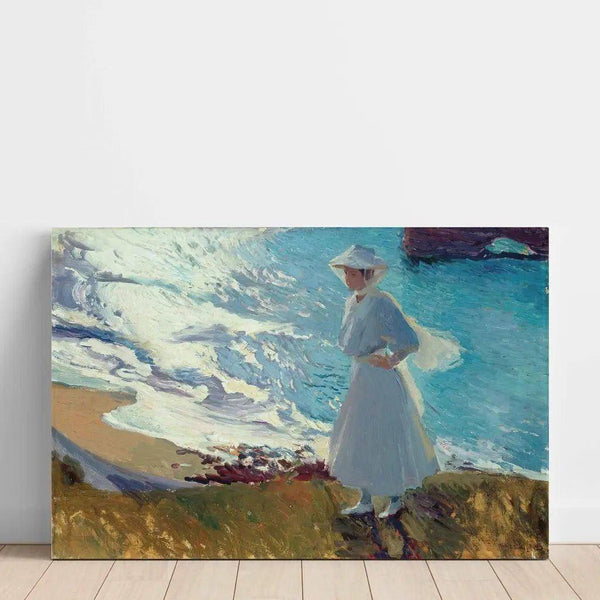
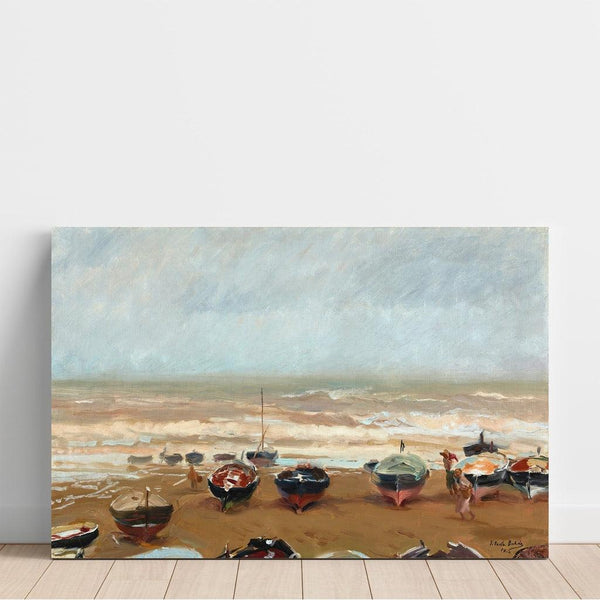
It is through his seaside scenes, however, that Sorolla lastingly imprinted himself on the collective memory. Walks on the beach, children at the water's edge and the play of reflections on the wet sand are among the motifs that recur most often under his brush. These subjects, imbued with everyday life and the open air, distil the essence of his research: to seize the moment, the clarity and the movement in a single pictorial impulse.
The luminist style: light as subject
Sorolla's style is recognised first of all by its treatment of light, which structures and animates all of his compositions. For him, the blaze of the sun is not a mere backdrop: it becomes a genuine subject, modelling bodies, fabrics and surfaces, playing on contrasts and reflections. This constant attention to Mediterranean clarity earned the painter his nickname of master of light, and connected him to the current often designated by the name of luminism.

Close to Impressionism through his taste for the open air and the instantaneous, Sorolla nonetheless retained an identity of his own. His touch, broad and assured, preserves the legibility of the figures and the solidity of the compositions, where Impressionism sometimes tends to dissolve forms. The painter liked to work from nature, on the motif, to capture the vibration of the air and the fleetingness of reflections; but he maintained a keen sense of drawing and structure, inherited from his training and from his admiration for the old masters.
From this synthesis is born a painting at once spontaneous and controlled, in which the freshness of direct observation is allied to a genuine pictorial ambition. It is this balance that largely explains the lasting fascination his canvases exert: they give the feeling of a world caught in the act, while revealing an accomplished craft.
Sorolla today: a legacy sought after in reproduction

More than a century after his death, Sorolla's work continues to draw a wide audience. His luminous scenes, in particular, appeal through their peaceful atmosphere and their visual energy, which cross the ages without losing any of their force. For many enthusiasts, these images of the beach and the open air embody a Mediterranean art of living, made of clarity, simplicity and movement.
Our gallery thus offers several of his most appreciated compositions in the form of reproductions. The painting "Strolling Along the Seashore" evokes the elegance of a seaside scene bathed in light, while "Children on the Beach, Valencia" restores the spontaneity of childlike figures at the water's edge. These reproductions make it possible to rediscover, at home, some of the artist's most characteristic motifs and to appreciate their solar palette.
To approach Sorolla through these works is to enter a world where light plays the leading role and where painting seeks above all to make life palpable. Between attentive realism and Mediterranean brilliance, his art retains a singular place in the history of Spanish painting, and continues to offer, to those who take the time to look at it, a visual experience of remarkable clarity.
Discover the full range of Joaquín Sorolla painting reproductions.