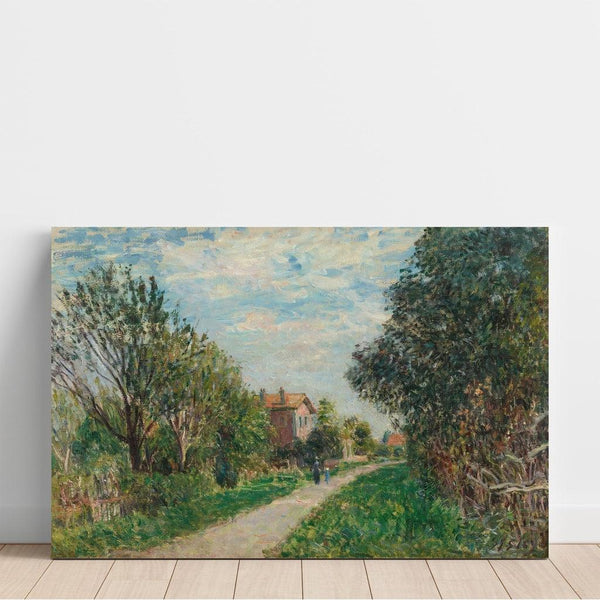
Among the founders of Impressionism, Alfred Sisley holds a singular place: less discussed in his lifetime than Claude Monet or Pierre-Auguste Renoir, he was nonetheless one of the most consistent and purest landscape painters of the movement. Faithful to the motif to the very end, he devoted almost his entire body of work to the rivers, villages and skies of the Île-de-France and the Loing valley. His canvases, now sought after by major public collections, offer a lesson in restraint and sensitivity that enthusiasts rediscover with undiminished emotion. This article offers a sober journey through his life, his manner and his legacy.
A life between Paris, London and Moret-sur-Loing
Alfred Sisley was born in Paris in 1839 to British parents. Intended at first for a career in commerce, he spent a few years in London before returning to France to devote himself to painting. In the early 1860s, he frequented the studio of the painter Charles Gleyre, where he met Claude Monet, Pierre-Auguste Renoir and Frédéric Bazille. From these friendships emerged the nucleus of a group that, by working in the open air and seeking to capture changing light, would transform landscape painting.
In 1874 Sisley took part in the first Impressionist exhibition, alongside his companions, and joined the group's subsequent shows. Throughout his life he faced persistent material hardship: recognition and commercial success largely eluded him, unlike some of his contemporaries. Settled in the outskirts of Paris, then lastingly in Moret-sur-Loing, he found there the motifs that would nourish his final years. He died in 1899, leaving behind a body of work long underrated and since fully reassessed.

Landscape as the only horizon
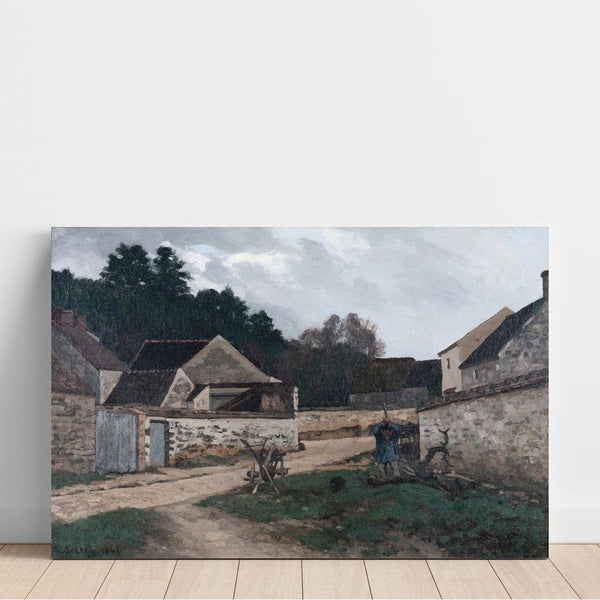
Where several of his friends alternated between portraits, scenes of modern life and still lifes, Sisley remained above all a painter of landscapes. This is undoubtedly what gives him his coherence: he tirelessly explored the water's edge, tree-lined paths, bridges, locks and village rooftops. The banks of the Seine and the Loing were his favoured territory, a familiar space he observed through the seasons and the hours.
This constancy is not repetition. By returning to the same places, Sisley sought to convey atmospheric variation: the way a low sky weighs down a landscape, the way a grazing light lengthens the shadows, the way water reflects and distorts the banks. "Road Along the Seine at Saint-Mammès" illustrates this attention to the river and its surroundings, where the composition is organised around the horizontal of the bank and the depth given by the line of the path. Nature is rendered without emphasis, with an accuracy of observation that earns Sisley his reputation as a discreet and exacting landscape painter.

Light, snow and water
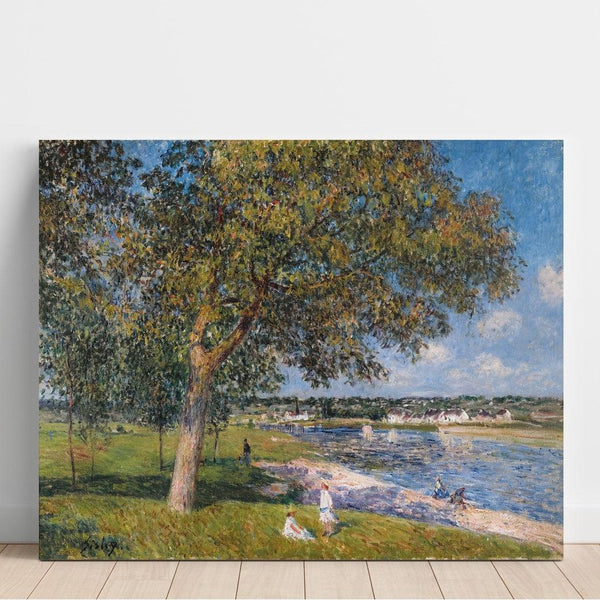
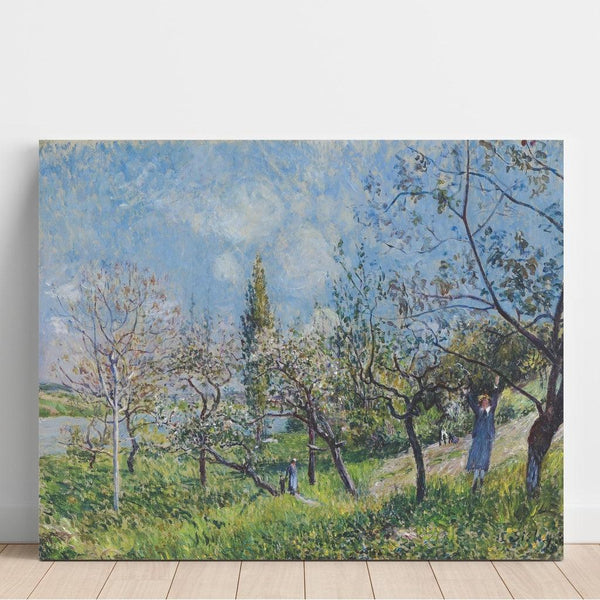
Sisley's style is recognisable by the delicacy of his touch and the importance he gave to the sky, often treated as the true subject of the canvas. His vast skies, cloudy or luminous, command the entire composition and set the chromatic tone of the landscape. His touch, fragmented yet restrained, modulates values with great delicacy, far from any heavy-handed effect. This economy of means lends his paintings a calm, almost silent atmosphere.
Sisley excelled particularly in effects of snow and winter, where the palette tightens around nuanced greys, bluish whites and browns. "Mooring Lines, the Effect of Snow at Saint-Cloud" bears witness to this interest in wintry scenes at the water's edge, where the layer of snow reveals the structure of the landscape and catches a cold, diffuse light. The painter also proved attentive to floods and inundations, motifs that allowed him to paint water invading the streets and reflecting the façades. In all these cases, the artist favoured sensitive observation over technical demonstration.

This approach makes Sisley an Impressionist in the fullest sense: he worked from nature, sought to render the moment and the changing conditions of light, and composed ordinary scenes that he elevated through the sheer quality of his gaze. His landscapes tell no story; they record a state of the world, a moment of calm between sky and water.
An Impressionist legacy to rediscover
The reassessment of Sisley's work came about gradually after his death. His landscapes now feature in the principal collections devoted to Impressionism, and his name stands as that of a master of the genre, alongside Monet and Camille Pissarro. He is credited with a remarkable unity of purpose and a sincerity that carry across the decades without losing any of their freshness. His way of painting water, skies and villages has lastingly influenced the representation of landscape.

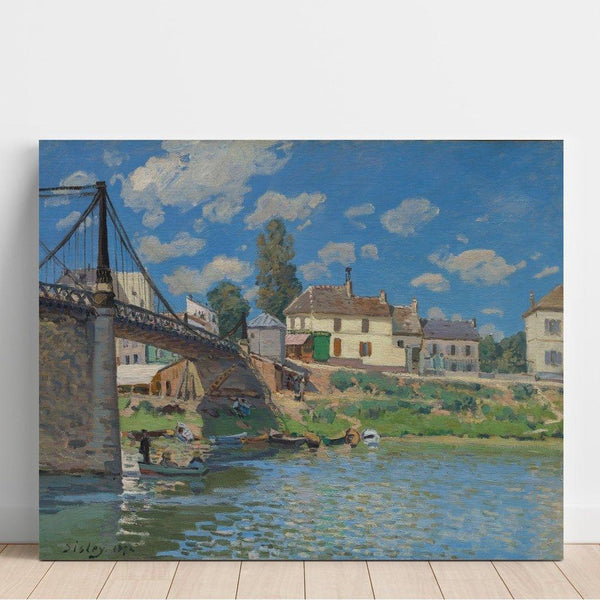
For those who wish to live alongside this painting, reproduction offers an accessible path faithful to the spirit of the artist. The "Painting La Seine at Bougival - Alfred Sisley" extends the river motif so dear to the painter, while the "Painting Le Pont de Saint Cloud - Alfred Sisley" recovers one of those bridges that punctuate his compositions and structure the crossing of the water. Hung at home, these reproductions recall the constancy of a painter who was able to find, in the most familiar landscapes of the Paris region, an inexhaustible source of light.
To discover Alfred Sisley is also to cast a fresh eye on Impressionism itself. Far from the most publicised figures, his work invites slowness and attention, that patience of the gaze which sets the great landscape painter apart. In following his rivers and his skies, one measures how much Sisley's painting remains, more than a century after his passing, an invitation to contemplate.
Discover the full range of Alfred Sisley painting reproductions.