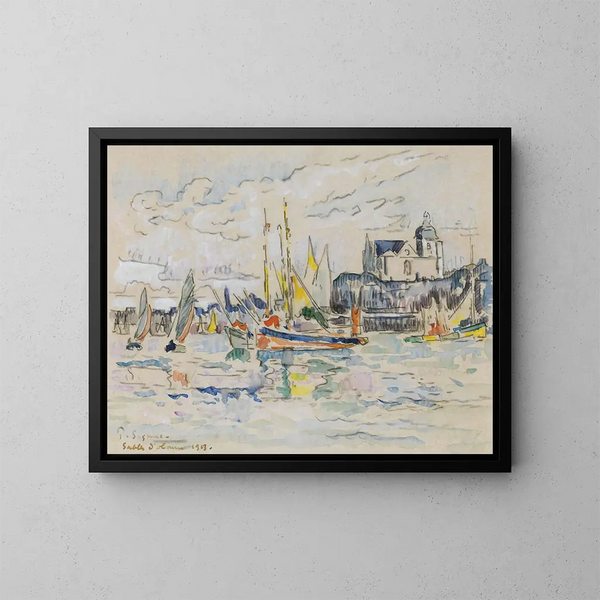
Paul Signac, born in Paris on 11 November 1863 and died in the same city on 15 August 1935, ranks among the decisive figures of modern French painting. A co-founder of Neo-Impressionism alongside Georges Seurat, he became its leader after the latter's death, then its most widely read theorist. A painter of harbours and Mediterranean light, an accomplished sailor, and president of the Société des Artistes Indépendants from 1908 until his death, he pursued throughout his life a simple yet demanding idea: to subject colour to a rigorous method without ever dimming its vibrancy.

From architecture to painting
Nothing destined the young Signac for the painter's trade. It was an exhibition of Claude Monet, visited in 1880, that decided his vocation: he then gave up architecture to devote himself entirely to painting. This youthful revelation explains the lasting kinship of his work with Impressionist paintings — a taste for the open air, attention paid to reflections and atmospheres, and the primacy of light over subject.
In 1884, he took part in founding the Société des Artistes Indépendants, a salon with no jury and no prizes where every artist could present their work freely. The event counts twice over in his biography: beyond the institution itself, which would support the Parisian avant-garde for decades, it was there that Signac met Georges Seurat. From this friendship would arise one of the most coherent movements of the late nineteenth century. True to this youthful commitment, Signac would hold the presidency of the Indépendants from 1908 until his death, ensuring that the salon remained open to rising generations.
Divisionism, a method of colour
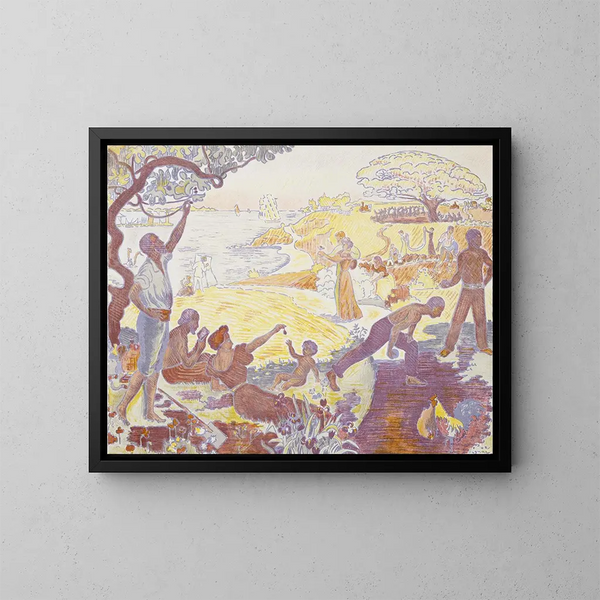
With Seurat, Signac devised Divisionism, also called Neo-Impressionism or, more familiarly, Pointillism. The principle rests on theories of colour, notably those of Chevreul: instead of mixing pigments on the palette, the painter lays down pure colours in small separate touches, and it is the viewer's eye that carries out the blending, at a distance, through optical fusion. The very name Divisionism sums up the approach: dividing the tone instead of mixing it, so as to preserve each hue's intensity. The canvas gains a particular luminosity, that of colours which stay pure right up to the gaze that recomposes them.

On Seurat's death in 1891, Signac became the leader of the movement. He took charge of its theoretical defence by publishing, in 1899, "From Eugène Delacroix to Neo-Impressionism", a landmark essay that places the Divisionist method within a historical lineage and sets out its foundations. To gauge what the two founders shared and what set them apart, one can place his canvases alongside the reproductions of Georges Seurat: in Seurat, an almost architectural rigour orders every composition; in Signac, the same discipline serves a freer and more vibrant colour, carried by deliberately contrasting harmonies.
A painter at sea, from Collioure to Saint-Tropez
Signac was a passionate sailor, who owned some thirty boats over the course of his life, including the Olympia. The sea was not for him one motif among others: it was a way of life, and often the very vantage point from which he approached his subjects. In 1887, a stay in Collioure inspired a series of Mediterranean seascapes; it is to this group that "Collioure. La Tartane" belongs. The light is rendered there according to the Divisionist method, through the juxtaposition of pure touches that the eye blends at a distance — a principle the painter would go on to apply from one shore to the next.
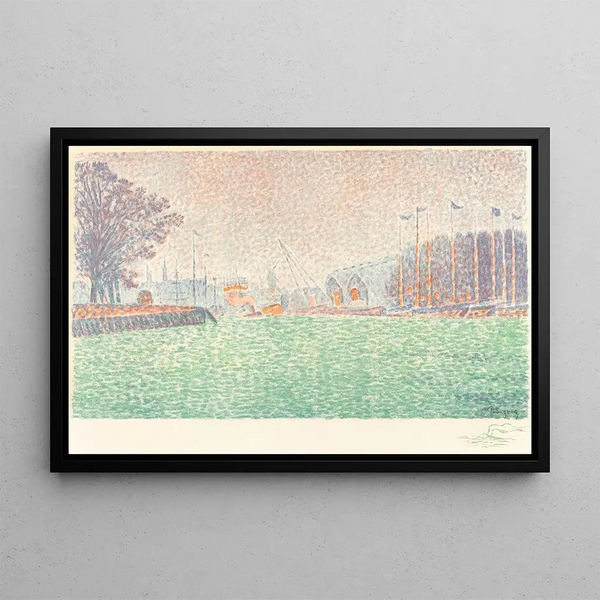
It was again by sea that he discovered Saint-Tropez, in 1892. The small Var harbour became his southern anchorage, and his enthusiasm drew many painters there, making this discreet mooring one of the hubs of modern painting. From that same year dates "Femmes au puits" (1892), now held at the Musée d'Orsay. The canvas thus dates from the very year the painter dropped anchor in the gulf, as if the new southern setting immediately called for an ambitious composition. Three years later, "La Bouée rouge" (1895), also at the Musée d'Orsay, captures the reflections of Saint-Tropez harbour: the frank colour of the buoy serves as an anchor point for the shimmering of the water, broken down into vibrant touches. "Le Port de Saint-Tropez" extends this dialogue between the painter and the place he had revealed, and which his work has lastingly associated with the light of the Midi.
Mont Saint-Michel at sunset
In 1897, Signac devoted a series to Mont Saint-Michel, of which "Mont Saint-Michel, Soleil Couchant" (1897) is part. The silhouette of the abbey rises there in a light fragmented into touches of pure colour: at this distance, the monument is no longer described stone by stone, it becomes a mass set between sky and shore, that colour alone brings into being. The subject, familiar above all others, is thus reinvented by the method, the eye recomposing of its own accord the blaze of the sunset from the juxtaposed touches. Working in series allows the painter to return to the same motif at different hours, and to make light, rather than the site, the true subject of the painting. This canvas appears in the gallery's catalogue under the title Mont Saint-Michel, Soleil Couchant – Paul Signac (1897), and offers a fine introduction to the period in which the painter applied Divisionism to the great sites of the French coast.

The broadened touch of the final years
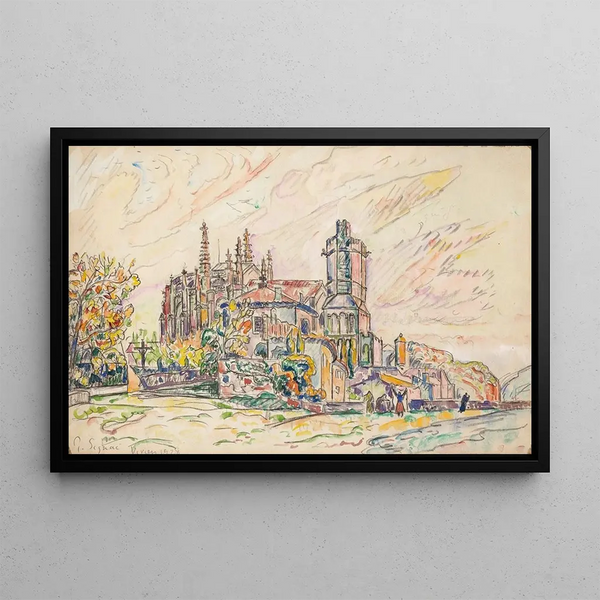
From the 1900s onward, Signac's manner shifted noticeably: the tight dots of the early years gave way to a broader touch, made of small juxtaposed squares of colour that give the surface a mosaic effect. "Avignon. Soir (le château des Papes)" (1909), held at the Musée d'Orsay, fully illustrates this final manner: seen from the Rhône, the Palais des Papes stands out against the sunset, in colours orchestrated like a musical score. Each square of colour plays its own note, and the chord arises from their assembly, in the manner of an instrumental ensemble.
At the same time, Signac established himself as a great watercolourist, notably through his series devoted to the harbours of France. This swift medium, which scarcely allows for second thoughts, suited these campaigns carried out from port to port, sketchbook in hand, along the coasts. From one end of this journey to the other, the definition of his art remains constant: a rigour of scientific spirit placed at the service of a free and vibrant colour, contrasting harmonies, and the sea as the dominant subject.
These seascapes in an interior
Signac's compositions lend themselves well to hanging in the home, precisely because of their optical principle: designed to be recomposed by the eye at a distance, they come alive in rooms where one moves about and where the vantage point varies — a living room, an entrance hall, a landing. Their pure colours bring light to a wall without imposing an intrusive motif, and their maritime subjects suit a classic interior as well as contemporary furniture with clean lines. Pairing two seascapes from different periods — the fine dots of the 1890s, the broader squares of the 1900s — also lets you follow, on a single wall, the evolution of a method.
The choice of format follows the logic of the works: seascapes benefit from being shown in generous dimensions, which give the Divisionist touch the space it needs to produce its effect, while a tighter subject suits a more intimate format, hung at eye level. Indirect natural light is enough to bring these fragmented surfaces to life over the course of the day. The reproductions of paintings by Paul Signac make it possible to bring this clear, constructed painting into your home, from the backlight of Mont Saint-Michel to the reflections of Saint-Tropez, by choosing the work whose tonality best answers the room that will host it.