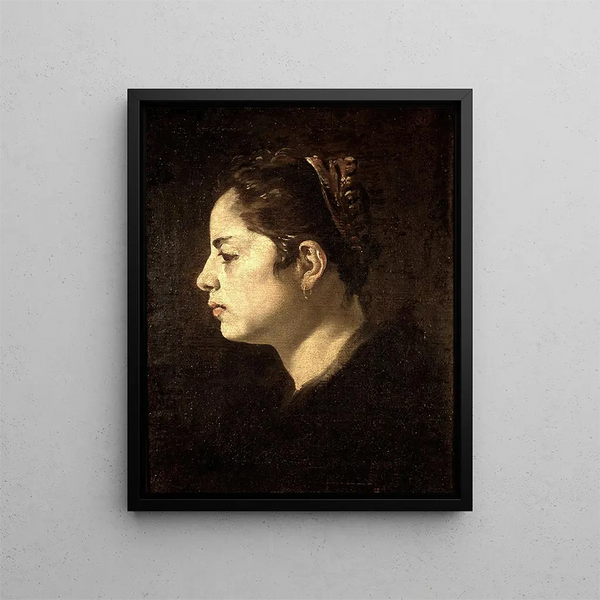
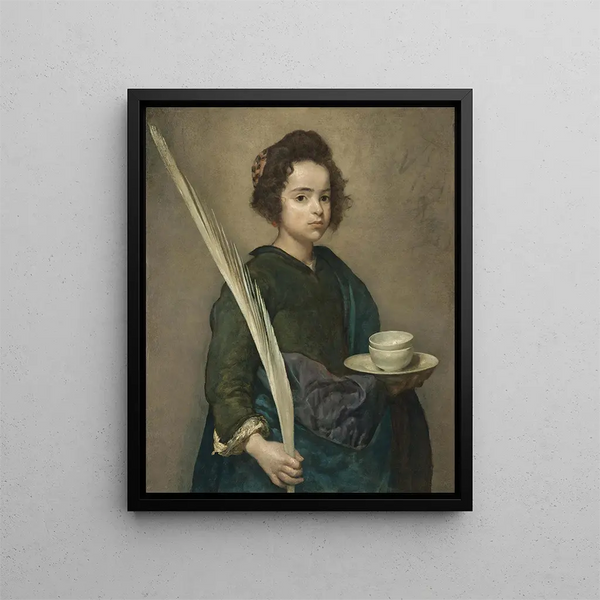
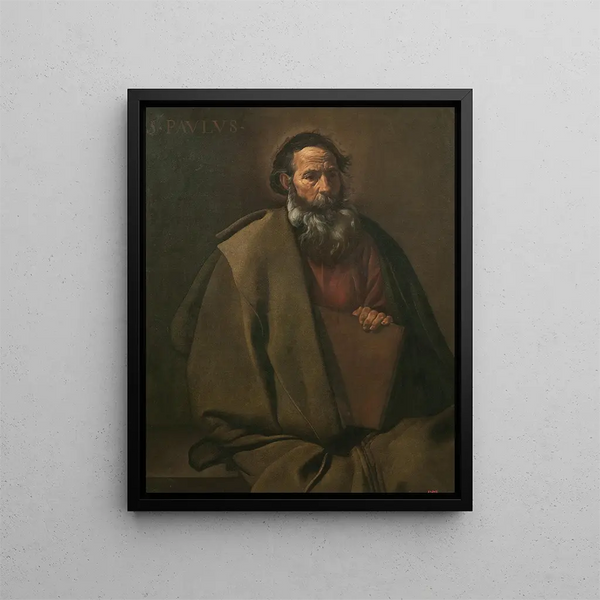
Baptised in Seville on 6 June 1599 and died in Madrid on 6 August 1660, Diego Velázquez moved through the Spanish Golden Age as a court painter and an observer of rare lucidity. Attached to Philip IV from 1623, he never again left the orbit of the palace, accumulating official duties up to that of chamberlain of the palace, without ever ceasing to steer his art towards greater freedom. From the Sevillian taverns of his youth to "Las Meninas" (around 1656), his painting unites psychological truth with such an economy of means that Manet would call him the "painter of painters". To retrace his career is to follow one of the most coherent pictorial adventures in European history.

The Sevillian years and the art of the bodegón
It all began in Seville, in the studio of Francisco Pacheco, where the young Diego entered as an apprentice from 1611. The training was rigorous, the bond lasting: in 1618, Velázquez married Juana Pacheco, his master's daughter. It was in this city that he produced his first significant works, the bodegones, those kitchen and tavern scenes enlivened by common figures, captured without idealisation or conventional picturesqueness. From the outset, the young painter asserted a clear stance: to paint what he saw, as he saw it, and to grant the most ordinary reality the dignity of a subject in its own right.
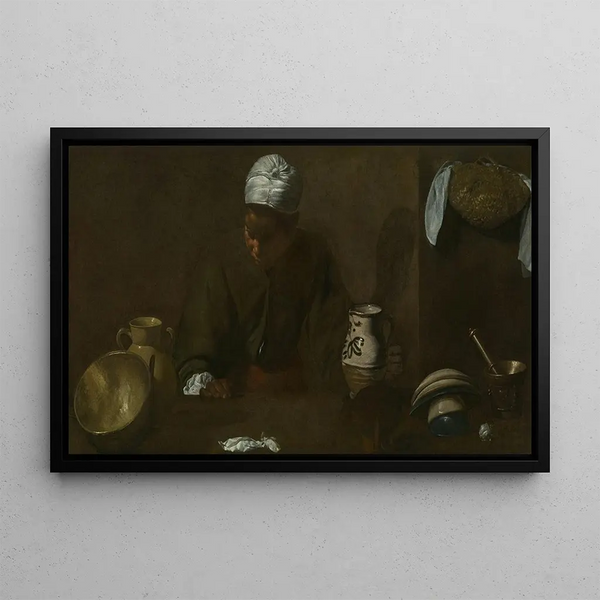
"Kitchen Scene" and "The Three Musicians", painted around 1618, show this direct naturalism at its starting point. Chiaroscuro sets the faces and hands apart against dark backgrounds; the objects — earthenware jugs, bowls, instruments — are painted with a striking truthfulness, each material rendered for its own sake. Nothing here is treated as a mere accessory: the pitcher receives the same attention as the musician's gaze. This equality of attention between the humble object and the human figure, asserted from the very beginning, would remain one of the guiding threads of the entire oeuvre, right down to the royal portraits of the following decades.
Painter to King Philip IV
In 1623, Velázquez was appointed painter to King Philip IV and settled in Madrid. He would remain a man of the court all his life, climbing one by one the offices of the palace up to the highest responsibilities. This singular position, that of an artist who had become an officer of the royal household, secured him constant access to his sitters and nourished a body of portraits of rare coherence: Philip IV, whose face he recorded throughout the reign, Queen Isabella of Bourbon, the Infante Balthasar Charles, but also figures from the circles of power, such as the "Portrait of Don Pedro de Barberana", a grave likeness in which the man matters more than the rank.

Two experiences broadened his horizon. In 1628, he met Rubens, then passing through Madrid; the following year, he set out for Italy, where he stayed from 1629 to 1631 before returning twenty years later, from 1649 to 1651. Over these years, his manner evolved appreciably: the brushwork gained in freedom, the paint grew lighter, and the court portrait, a codified genre if ever there was one, became under his brush an exercise in truth. With Velázquez, etiquette never erases the person; it frames them, and it is precisely in that gap that the emotion resides.
Rome, 1650: the candour of "Innocent X"
It was during the second Italian stay that one of the summits of the art of portraiture took shape. In Rome, in 1650, Velázquez painted the pope "Innocent X"; the painting is today held in the Doria-Pamphilj gallery. Its psychological candour has remained famous: no complaisance softens the pontiff's features, no conventional artifice interposes itself between the painter and his sitter. The ceremonial portrait, in principle charged with manifesting power, here becomes a study of character of unsettling acuity.
That such a gaze could have been turned upon the sovereign pontiff says enough about the authority Velázquez had by then acquired. The work left a lasting mark on the history of the genre: it proves that an official portrait can be at once protocolary in its form and implacable in its observation. Generations of painters would return to it as to a lesson in pictorial courage, and its reputation has never faltered since the mid-17th century.
The court jesters, an equal share of humanity
The Spanish court kept jesters and dwarfs, familiar presences about the palace. Velázquez painted them with the same gravity and the same attention as the sovereigns he served: neither condescension nor pity, but a face-to-face between equals. The "Portrait of the Jester Calabazas", painted in the 1630s, is an eloquent example: the gaze is captured without caricature, the brushwork becomes free, almost rapid, as if to leave the sitter his share of the elusive.
These portraits occupy a place apart in 17th-century painting. Far from any register of entertainment, Velázquez grants these men a full humanity, on an equal footing with that of kings and infantes. This ethical dimension of the gaze, rarely stated but everywhere palpable in his work, explains the lasting fascination these canvases exert: in them we discover a painter who does not judge, who does not flatter, and who looks at each face as an enigma worthy of being painted.
"Las Meninas", summit and testament

Around 1656, Velázquez painted "Las Meninas" (Prado Museum, Madrid), often held to be a summit of Western painting. The Infanta Margaret stands at the centre, surrounded by her maids of honour; the painter has portrayed himself at the easel, brush in hand; at the back of the room, a mirror reflects the royal couple. The play of gazes and perspective that results is inexhaustible: who is looking at whom? Where exactly does the viewer stand — in the place of the king and queen whom the mirror reveals? Each answer opens another, and the painting can be read again and again, which explains why it has never ceased to feed the reflection of painters and writers alike.
The technique of the final years reaches its fullness here. The brushwork, ever freer and more sparing, proceeds by "patches" that, seen close up, appear almost abstract and resolve at a distance into fabrics, hair and lights. The blacks and greys attain a richness held to be unequalled in the history of painting: far from being absences of colour, they unfold a whole range of nuances. Made a knight of the Order of Santiago in 1659, Velázquez died the following year, on 6 August 1660. It was this freedom of execution, this sovereign economy, that Manet saluted when he spoke of the "painter of painters": a modernity that each era rediscovers in its own way.
Living with Velázquez: formats, light, hanging
Velázquez's palette — deep blacks, silvery greys, tempered browns and ochres — accords naturally with today's interiors, whether pared-down or more classical. A portrait such as "Pope Innocent X", after a workshop version, imposes a strong presence: it calls for a clear wall, a hanging at eye level and soft lighting that preserves the depth of the tones. In a living room or a study, such a work structures the space on its own and gains from being left without immediate neighbours.
The bodegones call for other locations: "Kitchen Scene" or "The Three Musicians" naturally find their place in a dining room, an open kitchen or an entrance hall, where their common figures and their objects painted as close as possible to reality converse with everyday life. Medium formats suit them well, while court portraits can bear more generous dimensions. The reproductions of paintings by Diego Velázquez make it possible to compose a gradual hanging, from the bodegón of youth to the portrait of maturity, and to follow at home the evolution of a brushwork that never ceased to free itself.
To broaden this dialogue, the reproductions of Baroque works offer coherent neighbours: the 17th century loves correspondences of chiaroscuro, dark backgrounds and restrained harmonies, which answer one another from painting to painting. Hung with measure, one or two works per room, these images do not overwhelm an interior: they inhabit it, as the painter inhabited the palace of Madrid — present, discreet, essential.