A major figure of seventeenth-century European painting, Peter Paul Rubens embodies the height of the Flemish Baroque. A painter of exceptional productivity, an erudite humanist and an accomplished diplomat, he left his mark on his era through the scale of his compositions, the vividness of his colours and the movement that animates his figures. His work, spanning the religious, mythological and historical genres as well as portraiture, continues to exert a considerable influence on the history of art. This overview offers a look back at his career, his achievements and the enduring reach of his art.
A career spanning Flanders and Italy
Peter Paul Rubens was born in 1577 in Siegen, in Westphalia, into a family originally from Antwerp then settled in Germany. After his father's death, the family returned to Antwerp, where the young Rubens received a careful humanist education, steeped in Latin and classical culture. This intellectual grounding, rare among the painters of his time, permeated his work lastingly and eased his relations with the learned elites of Europe.
Around 1600, Rubens travelled to Italy, where he stayed for nearly eight years. There he closely studied the masters of the Renaissance and of Antiquity, between Venice, Rome and Mantua. In the service of the Duke of Mantua, Vincenzo Gonzaga, he deepened his knowledge of Venetian colour, notably that of Titian, as well as the sculptural power of Michelangelo. This Italian sojourn formed the foundation of his artistic maturity and gave him a visual culture of rare breadth.

Back in Antwerp in 1608, he quickly established himself as the most sought-after painter in the Southern Netherlands. Appointed court painter to the archdukes Albert and Isabella, he set up a prosperous and soon renowned workshop. The fervour of the Catholic Counter-Reformation offered his art a vast field of expression, while his reputation already extended beyond the borders of Flanders.
The scale of a Baroque body of work
Rubens's art is distinguished by an energy and a monumentality that define the Baroque of northern Europe. His religious compositions, intended for churches and ecclesiastical patrons, stage powerful figures, ample drapery and dramatic light. They answered the expectations of the Counter-Reformation, eager to move the faithful through emotion and grandeur. A work such as The Holy Family with Saint Elizabeth and Saint John attests to this devotional vein, in which the intimacy of the figures is combined with a learned mastery of composition.

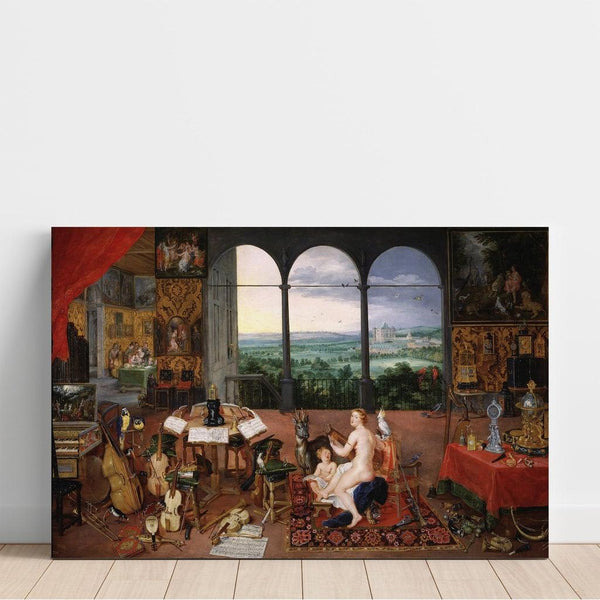
The painter also excelled in mythological and allegorical subjects, where his taste for anatomy, movement and the sensuality of flesh found its fullest expression. Among the collaborations that punctuate his career is the series of the five senses, produced with Jan Brueghel the Elder, of which Sight illustrates the richness. This work, the fruit of a partnership between two complementary talents, blends Brueghel's descriptive refinement with the vigour of Rubens's figures, in an exuberant celebration of painting, collecting and the gaze.
Hunting scenes constitute another remarkable facet of his output. In them Rubens deploys a striking dramatic energy, where men, horses and wild beasts intertwine in a whirlwind of opposing forces. These compositions, much admired in his lifetime, were widely reprised and disseminated by his workshop and his followers. The Tiger, Lion and Leopard Hunt, in the wake of Rubens, prolongs this tradition and gives the measure of the lasting appeal these images of tension and movement held.
Portraiture and the place of Hélène Fourment

Although Rubens is first and foremost famous for his great religious and mythological machines, he was also an exceptional portraitist. His portraits capture the presence of his sitters with a particular ease and warmth, served by a luminous palette and a free touch. In this domain, his private life directly nourished his art.
In 1630, a few years after the death of his first wife Isabella Brant, Rubens married Hélène Fourment, then very young. She became a constant source of inspiration and appears in several of his paintings from his final years. The Portrait of Hélène Fourment illustrates the tenderness and admiration the painter felt for his model, while revealing his ability to render the softness of complexions and the brilliance of fabrics. These intimate works, imbued with serenity, contrast with the public grandeur of his official commissions and shed light on a more personal side of his sensibility.
A lasting legacy and influence

Beyond painting, Rubens was a man of influence, combining artistic activity with diplomatic missions in the service of the courts of Europe. His travels, notably to Spain and England, strengthened his international prestige and earned him honorific distinctions. This dual career, rare for an artist, testifies to the esteem in which he was held by the sovereigns of his time. He died in Antwerp in 1640, at the close of a life of intense fruitfulness.
Rubens's workshop, where numerous collaborators and pupils worked, among them Anthony van Dyck, played a decisive role in the diffusion of his style. His compositions were reproduced, engraved and imitated far beyond Flanders, lastingly shaping European Baroque painting. The energy of his forms, the boldness of his colours and the generosity of his figures inspired generations of artists, from the seventeenth century to the modern painters who saw in him a model of pictorial freedom.
Even today, Rubens's work remains an essential landmark for understanding the Baroque and its relationship to movement, light and emotion. To contemplate his paintings, or to appreciate their reproductions, is to enter a world of rare vitality, where erudition is combined with sensuality and where great history painting sits alongside the intimacy of portraiture. This singular balance explains the fascination he continues to exert and the eminent place he occupies in the history of Western art.
Discover the full range of reproductions of paintings by Peter Paul Rubens.